Sunday, June 20, 2010

Football Season

I can trace my real fascination with the World Cup to our trip to Europe in the Summer of 2002. We were in Paris, just barely getting by on our rusty French, when Senegal beat France in what has sometimes been called the greatest upset in football. Then we moved on to England, where I was scheduled for a week in the Parker Library in Cambridge.

Because Rose and I have been in Cambridge more than just about any other city, and because I'd worked in the Parker for six weeks in 1997, a visit to Cambridge almost always feels like being at home. And Cambridge was very much caught up in the fortunes of the England team, and the St George's Crosses were everywhere, including on iced cookies. At first, I wasn't too involved in the football fever; I had talked to the librarian at the Parker, and asked her if she was following the England team, and she shrugged it off, suggesting that she didn't care much one way or the other. And so I thought that was the way to see things.

But one afternoon, Rose and I were in the market in downtown Cambridge, right at the time when an England match was going on. Every stallholder in the market seemed to have the match on the radio, and a few had tiny tvs they were peeking at now and them. But everything else was business as usual.

Until England was given an penalty kick, and David Beckham was lining up to take it. Suddenly, everyone in the market started paying attention, and people crowded closely around the few tvs. The crowd grew quiet, until Beckham made the kick. There was a great shout, and everyone was happy, and even the foreign visitors couldn't help feeling like we'd been part of a community moment. The next day, even the librarian told me she had managed to find a way to listen to the match.

We were on the bus to Heathrow when the next match was being played, and Rose let me try to tune in the battery-powered radio we had to listen in. At least three or four other people on the bus were also listening, and the other riders got constant updates, and certainly heard our semi-conscious sounds of excitement and tension. It was a strange kind of shared experience: we were all wearing headphones, listening alone. But we were part of a group, too.

This year, I've caught maybe half a dozen matches so far. I usually say I like to watch sports on tv because something always happens, and it never really matters. But But Beckham's penalty shot in the Cambridge market mattered, to me and to Rose at least. I'll never forget it.

Thursday, June 10, 2010

Gems from the archive

This summer, I'm hanging out in the West Virginia and Regional History Collection, aka the university archives, researching the folklore materials that were collected under the auspices of the state branch of the Federal Writers Project in the late 1930s/early 1940s.

An offhand comment about spending my summer in the "musty old archives" on Facebook prompted my friend Susan, an archivist, to object, saying, "Musty old archives, indeed! My profession is filled with angst about 'dusty, old,' but maybe we should just embrace it."

In the spirit of complete disclosure, I should note that I have never worked in an archive that was musty or dusty (with the possible exception of the Ohio State Folklore Archives, which were in the basement of Denney Hall when I was in grad school, and were just depressing, and not dusty or musty).

Actually, all of the archives I've done research in have been "clean, well-lighted places" of calm and quiet.  As a proud and professional nerd, I love doing archival research.  I can get absorbed in files for hours and not be remotely aware of anything that's happening around me--it can be a very Zen experience.  It's one of the few academic tasks I can engage in where my anxieties about getting published and getting tenure melt away in the pure pleasure of discovery.

Anyway, that's a long preface to presenting some of the more amusing tidbits I've discovered recently.  As with all archival material, it's a mixed bag:  some brilliant stuff, some appalling stuff, and a lot of random stuff that makes you wonder why on earth anyone bothered to save it.

The guy who collected folklore in Doddridge County, for example, must have been some high-ranking official's nephew, because not only does he not have a clue what folklore is, he can't spell worth a damn.  One of the things he seemed determined to collect were his interviewees' statements about their "ideals." And thus he explains that one man's greatest wish was to "give the wormest receptions to the staranger as well as his closest friends as he pollible can do."  Truly, words to live by.

It's items like that that make me appreciate how well-written and thoughtful most of the other materials are, and already, collectors from certain places are emerging as tremendously skilled fieldworkers (like Charlotte Clauze from Jefferson County, who I hope to find out more about).

But today's gem was the following parody of Joyce Kilmer's "Trees," a poem that richly deserves to be parodied.  (You know:  it's the one that starts "I think that I shall never see/ A poem lovely as a tree.")
I think that I shall never see,
Along the road an unscraped tree.
With bark intact, and painted white,
That no car ever hit at night.
For every tree that's near the road
Has caused some auto to be towed.
Side-swiping trees is done a lot
By drivers who are not so hot.
God gave them eyes so they could see,
Yet any fool can hit a tree.
...More as I come across it!

Image at top is from the Library of Congress' fabulous WPA Poster Collection

Tuesday, June 1, 2010

Memorializing Memorial Day

My mother, sister, nephew, brother, and sister-in-law were all here in Morgantown for the last few days.  Being Memorial Day weekend--and a hot, sunny one at that--it included traditional elements like bike riding, bratwurst, ice cream, and outdoor beer drinking.

But perhaps the most traditional thing we did was to visit a family cemetery yesterday morning.

All of us Hathaway kids have very un-fond memories of Memorial Day cemetery trips, riding in our Uncle Cleo's un-airconditioned car along twisty mountain roads in central West Virginia, en route to the family cemetery in Grantsville.

In the bad old days, Uncle Cleo would also smoke a cigar as he drove; later, he just chewed them.  But he was still reluctant to turn on the AC, even after he had it, or to open the car windows.  A lifelong hill-dweller, he also didn't believe in carsickness, which meant that any complaints were duly ignored until the critical moment.  My sister Pam and I both associate Memorial Day with throwing up on the side of the road...and then getting back in the car to continue the journey.  I think all of us were incredibly relieved when we got old enough to skip the annual trip, and I don't think any of us had been on a cemetery visit in well over twenty years.

This year's visit was completely unplanned, and was not to the family plot in Calhoun County, but to one here in Monongalia County.  After Mom got to town last Friday, she told me that she'd discovered, while doing some genealogical research, that some ancestors of hers were buried in a small cemetery in the Morgantown area.  We looked it up online and discovered that it was just over on the other side of the river,  in what's now Westover.

Our first attempt to find it was less than successful.  Note:  do not trust GPS to get you to someplace like this.  The road the GPS directed us to led to an auto salvage yard that was blocked by a beat-up old junker.

We attempted to find another way back to the cemetery, and ended up on a dead-end road where several inquiries yielded nothing but blank looks.  The guy at the end of the road said his neighbor up the hill might know, and yelled up to him, but got no response.  He told us to drive on up the hill and ask J. R. if he knew where the cemetery was.

So, ignoring the "No Trespassing-Private Property" sign, we drove up the steep gravel driveway, Mom saying, "This is so West Virginia!  I love it!"  (She grew up in the southern part of the state, by the way, and so means that in the best way:  what she loves is the fact that folk knowledge trumps official knowledge every time in these situations.)

At the top of the hill, we all had some second thoughts when we saw the Confederate flag flying from J. R.'s porch.

As you can see, Pam and I threw our mother to the dogs (literally, as it turns out, as J. R. had a huge, enthusiastic dog named Bo who kept jumping on mom).   We stayed in the car, while she went out to do the talking.

This wasn't as mercenary as it sounds:  mom decided a number of years ago that one of the few perks of aging was the fact that she could do pretty much whatever she wanted, because "little old ladies" are essentially invisible in our culture.  Plus, she has good Southern manners and the ability to chat up anyone--qualities I sadly did not inherit.

J. R. actually turned out to be a friendly guy, but he had no idea where the cemetery was, either.  He said it was too bad we hadn't gotten there a year earlier, because his dad, who lived to be 99, would have known.

So, we drove on.  Bo escorted us down the driveway...and down the road...and then ran after the car once we were able to speed up and pass him.  The last we saw of him and J. R. was when we turned around to see J. R. chasing Bo down on his four-wheeler, trying to herd him off the road.

Astonishingly, all of this happened less than five miles from my house.  A reminder that this seemingly urbane college town is situated right smack in the middle of a very rural area.

Back at home, we looked the cemetery up on Google maps and got a very different set of directions--and ones that looked like they'd actually work.  So, on Monday morning, we set out again, and this time were able to find it.

As you can see, the Burnt Meeting House cemetery has been in existence for 250 years.  With a little hunting, we were able to find the grave of John Lough, my great-times-three-or-four grandfather.

His stone is very elaborate, and features the following sobering inscription:
Behold me now, though soon forgot
I have past the vale which you have not.
Remember friend, you are born to die
And turn to dust as well as I.
There were several other very old headstones in the same part of the cemetery:  this one, for John's wife, Anna, is interesting because the carver made no attempt to line out the inscription, but simply started a new line in the middle of words when he ran out of room.


This one is simply a rough piece of rock, carved by hand:


Contrast those with these more modern monuments in the cemetery.  This one has a statue of the Buddha propped up in front of it (I'd really like to know the story here):


And this one exemplifies the contemporary trend for monuments to celebrate the individuality of the people they commemorate.  It's worth clicking on the photo for a larger view, so you can see the detail.  I especially like the fact that the couple is pictured sitting in a swing on the left-hand side, and are also pictured in a photograph with their wedding date in the center of the stone.

Frankly, I can't think of anything that shows how radically different our sense of self is now than it was when this cemetery was first established.  John Lough used his headstone to remind us of the vanity of individuality by emphasizing the fact that we'll all be dust one day.  The Maxwells' monument seems to be an attempt to freeze that individuality for eternity. 

All I know is, Memorial Day felt ritually complete to me today after we left the cemetery.  It took me thirty years, but I think I finally understand why these visits matter.

Saturday, May 29, 2010

Paint Peeling

My first car was a 1947 Plymouth Business Coupe, exactly twice as old as I was when I first started driving it. My dad, at the time, was in his middle forties, and it seemed to me that he knew everything that needed to be known about fixing up an old car. His 1953 Studebaker was a fixture in my childhood, parked in the big old barn on our farm, and I probably wanted to drive an old car partly because that old Studebaker had always been there, and because even then I loved old things. Back when I had the Plymouth, my dad helped me rebuild the old straight-six engine; fill, sand, and prime the body; and replace the wiring harness and the brake lines. When I was seventeen, all that work seemed kind of fun: it was grown-up work, and it was my car.

So earlier this spring, when my dad asked me to come out for a few days in May to help him work on his 1955 Studebaker President, I could hardly refuse. Now I am the one who is in my middle forties, and he is retired, and he's the one with the old car (or old cars, really, though the '53 Studebaker he now has is completely restored and doesn't need any work at all). He wanted to take off the red paint he'd put on the car a couple of years earlier: for various reasons, it had to go. The first picture here shows what the car looked like when I got there on Monday.

He had most of the stainless trim off and the rear fenders, too: a few hours' work, he said to do all that. Not soon after I got there, he got to work with the "orbital sander" (powered by a remarkable combination of air compressor pumps (see the second picture), one of which is suspended by chains from the ceiling of the garage: don't ask!). I got to work with a piece of 80-grit sandpaper.


My job, as I had suspected all along, was to get down on the ground and sand the parts that would be the hardest for a seventy-one-year-old to work on. I started with the rocker panels, which had been brand new when he'd first fixed up the car a couple of years ago. Two or three hours later, I had them pretty much down to bare metal. Then I got going on the front fenders. At one point I asked if the President was the biggest car they made, and he said it was the biggest '55 model; there is a lot of surface area on that thing.

The next day, we started all over again, though this time I was going at the lower half of the doors with an old electrical sander that had been my Grandpa Schmidt's. With some really rough 40-grit, it did a pretty nice job, and I had most of the paint off the driver-side doors by the late afternoon, and my dad started working on the parts of the front fenders I had left for him.

By now I was sore from running the sander (and from lying or sitting on the concrete!) and bored, too. So I saw a ragged edge of the paint I'd been working on at the back driver's-side door, and I picked at it a moment, and it peeled right up. Carefully, over the next hour or so, I peeled most of the rest of the paint on that door right off, leaving a perfectly smooth primer layer behind: it might be slower to peel the paint than to sand it, but there would be less work left afterwards for the next round of painting.

So the next day, before I left, I peeled most of the passenger side doors, and about half of the roof. The paint on the front door mostly came off in one giant piece, though I could only pull it free a few millimeters at a time. Here's what the car looked like when I left, with about half the paint off and a good bit of work left to do (but very little of it near ground level!). The grey areas are places where the peeling worked; the blackish mottled areas are places where we sanded; the bright red areas are the paint that still needs to come off.

My dad still knows a heck of a lot more about fixing up an old car than I do. But part of it, I know now, is in just doing the work. For three days this week, I pretty much just worked with my hands, and my fingers are still a little sore.

And while the appeal of the work isn't at all the same as it was when I was seventeen, and I was working on my car, there was still something satisfying about the work. And the car looks worse now that it did when we started, but I know it's a only a stage it needs to go through. These three days of work have given me a different perspective on what my dad must have been like almost thirty years ago, when he was in his early and middle forties, and I was too young to see him clearly at all: but back then, he was still young enough to get down on the ground and do the really hard stuff that I just didn't know how to do.

And when he finishes the prep, and gets the car painted, I know it will look better than it did before this week's work. And I know I'll take a bit of pride in the final product. And I wonder what I'll be working on when I'm 71.

Saturday, May 22, 2010

More on Monongah

Awhile back I wrote about Dear, Pretty Fairmont, the next major town south of Morgantown, and promised that eventually I'd return to the issue of my family's connection to coal, always a troublesome topic in West Virginia.


In that post, I described the Heinz History Museum's exhibit about the 1907 Monongah mine disaster that Tom and I had seen in Pittsburgh in March, just the week before the deadly explosion at the Big Branch Mine in Montcoal, WV.

In fact, a conversation about that exhibit was what prompted my mom to show me the scrapbook about my grandfather, her father, that I mentioned previously. I'd told Mom how surprised I'd been to discover how close Monongah was to Morgantown. Monongah is, in fact, just outside of Fairmont. Mom reminded me that my grandfather had worked as a mine surveyor in that area, and not long after the time of the explosion--probably sometime in the decade between 1910 and 1920.

And there, in the scrapbook, were a couple of photos of him on the job as a surveyor, with a caption—in my grandmother’s very distinctive handwriting—noting that the mining company he worked for was based in Fairmont, the closest “big” town to Monogah.

Mom told me stories about her father that I’d never heard: that he lost both parents before he was 17, and lived with an aunt and uncle; that he worked as a mine surveyor during the summers to raise tuition money to study at WVU.


And she reminded me of a story that I had heard before: that when he died in 1966, he wanted to be cremated, although that was hardly ever done, and was even considered sort of blasphemous in conservative Christian circles. But he explicitly said he never wanted to be buried underground because of his experience working in the mining industry. She wasn’t sure whether he’d ever actually been down in the mines—his job as a surveyor, of course, was all above-ground—but clearly he’d seen and heard enough about it to know that he didn’t want to spend eternity there.

Given his geographic and historical proximity to the Monongah disaster, it's no wonder he didn't want to be buried. In those early years afterward, the whole area must have been haunted by the shadow of that event.


All of this motivated me to set out on a little fact-finding mission. Though I’ve been to Fairmont countless times, I’d never gone there with the express purpose of seeking out history and family connections to it. Tom and I went in search of a memorial about the disaster that we’d seen photos of at the Heinz exhibit. We passed through Monongah--essentially just a turn in the road--once, twice, three times on US 19 and saw nothing even faintly resembling a memorial.

But we did find a flea market we’d been to once before, so we stopped in and asked the woman at the front if she knew where the memorial was.

She directed us, in classic West Virginia fashion, to turn right at such-and-such a landmark, and to go down the hill and over the bridge and we’d find it. Turns out the "Monongah" on Route 19 isn't the actual heart of Monongah, the old coal-camp town, which was built down in the river valley below the "big road."

Monongah is a strange little place; the memorial (a plaza encompassing a statue of the "Heroine" and an elaborate cast-bronze bell) and a very 1950s town hall are about all that now hold its center together.

Tom and I walked down the two blocks of the main drag, and the architecture told the story of a place that had clearly been bustling at the turn of the last century.  It was almost European in feel: a narrow street shadowed by two-story buildings that are separated from the road by only the narrowest strip of sidewalk.


These were buildings designed for commerce on the ground floor and residences above.  Precarious looking second-story balconies (or empty spaces where they’d once been) conjure images of immigrant Italian wives hanging laundry, leaning on railings, being careful not to look too far up or down the street in either direction for fear of breaking the illusion that they were still in their home villages in Molise, the region of Italy that most of the miners migrated from.


At one end of the street stand two substantial brick buildings bearing the impressive carved-stone names of "David Levy" and the "Blumberg Bldg." So clearly, there were probably Jewish merchants plying their trade here, too. All of these buildings are now empty, or nearly so.
The memorial incorporates two fascinating bits of folklore that I'd learned at the museum:  The day of the explosion was the feast day of St. Nicholas, and many of the miners had taken the day off for the observance. 


Consequently, they weren't in the mine when the explosion occurred, and were spared. The devout claimed that St. Nicholas had spared the miners. The bell--designed and cast in Molise and dedicated in Monongah in 2006--commemorates this miracle, asking for St. Nicholas' intercession.

The statue of the "Monongah Heroine" tells an even more interesting story. The inscription below the figure says "In the excess of her sorrow, brave beyond words." These words are meant to honor the many women who were widowed on that day, but especially one named Caterina Davia, whose story I first encountered at the museum exhibit.

  
After her husband's death, Caterina seemed to lapse into deep grief bordering on madness: for the remaining 30 years of her life, she made several trips a day to the collapsed mine, each time loading a burlap sack with coal and carrying it back to her home, where she deposited it in a pile.

By the end of her life, she had hauled several tons of coal from the mine to her home. The pile towered over the house. Talk about a concrete way of measuring your grief. According to the story, a newcomer to town looked at the coal pile and accused Caterina of stealing it for her own use. She replied, "I'm not stealing it. I'm lifting the weight from my husband."

Jo Ann Dadisman, a colleague here at WVU who's a professional storyteller, is developing a story about Caterina, and I was privileged to hear an early version. It is incredibly moving.  Jo Ann also offered a different take on the "St. Nicholas miracle":  while the official version suggests that piety kept the men out of the mines on that day, Jo Ann contends that in fact, most of them didn't show up to work because they'd gotten too drunk celebrating the feast day the night before.  In fact, it's likely that many of the "men" killed in the mine that day were, in fact, women:  wives who'd gone in their hungover husbands' stead, because you only got paid for the coal you brought out on any given day.  

For the same reason, many men also brought their young sons into the mine to help.  So, the estimate of 361 men killed in the Monongah disaster is probably a gross underestimation.  Or rather, there may have been that many men killed, but an unknown number of women and children likely died in the mine, too.


It's chilling to think of my own grandfather standing above ground near Monongah, undoubtedly wondering himself about the countless dead that lay below the surface he was surveying.  


This area continues to haunt me, and I welcome its ghosts.


Photo at the top of the post is of Monongah as it appears today, down in the river valley below Route 19.  In the surveying photo, my grandfather, Harry F. Toothman, is the man on the right.

Sunday, May 16, 2010

Lost & found video

My brother Mark recently digitized a reel of 16mm film that my Mom had found. It was in bad shape--had eroded and discolored over the years, and was very fragile.

But when he got it somewhat cleaned up, it turned out to be a film that my Dad had made the summer he and Mom started dating, in 1950. According to Mom, Dad was taking some kind of an "education A/V" course, and had to shoot and edit a short film.

This is the result. I call it "Mom & Dad Go on a Date," and it's impossibly sweet.

(It's a silent film, so don't worry that you're missing something sound-wise.)


Readers familiar with West Virginia University might recognize the setting: Women's Hall, now Stalnaker Hall. It's one of the most visible buildings on campus, situated at the very top of the hill above the academic buildings. And yes, those million flights of stairs are still there, too. And I'm sure anyone running up those stairs probably stops running at about exactly the same point my dad does in this film!

Thursday, May 6, 2010

Teacher Appreciation Week


The national PTA has designated May 2-8 as Teacher Appreciation Week, and with each passing year I come to appreciate teachers more and more. My classes are largely composed of preservice teachers, and part of my job is to serve as the university's liaison to a local high school. So I see how much teachers these days are expected to juggle, and I am regularly humbled by how much work they do, under so many constraints and demands, with such inspiration and determination. Frankly, I wouldn't last a week.

Recently I had a conversation with a friend that turned toward stories about former teachers, and I said that I felt increasingly lucky and grateful that I can only think of one truly awful teacher I had in elementary school. My friend looked astonished, and after a pause, said, "You don't know how lucky that is." There were several real clunkers in high school, but by that point you're not spending all day every day with a single teacher, and you generally have like-minded friends to compare notes with and provide some perspective.

So, I thought I'd take a moment to publicly thank some of the teachers I've had who inspired me, nurtured me, challenged me, and generally did their jobs well (and, I imagine, with very little thanks).

First up is my first-grade teacher, Molly Palsgrove (later Molly Davis). She was fresh out of college and we were her first class, though you'd never have known that by the grace, intelligence, and gentle authority she showed in the classroom.

I still remember learning the "McDonald's is your kind of place/They serve you rattlesnakes" song from her, and recall the mock presidential election we held (to parallel the McGovern/Nixon race), with classmate Michael Meckler as our candidate. (For the record, I still think Meckler '72 was probably the strongest ticket.)

When our class entered fifth grade, Miss Palsgrove switched to teaching that grade, so many of us had the pleasure of having her again. That year, she taught us a dance to The Osmonds' "Down By the Lazy River" that's still built into my muscle memory.

The year our class graduated from high school, Miss Palsgrove (by then Mrs. Davis) was named the Ohio Teacher of the Year. I went to visit her at Cassingham Elementary several years ago, and remarkably, she looked exactly the same, even in her 30-something-eth year of teaching. And she still interacted with students in the same loving, firm, but playful manner that she always had. I feel blessed that my public-school experience had such an auspicious beginning.

I was equally lucky in my second-grade teacher, Mrs. Arlene Robinson. More seasoned than Miss Palsgrove, she too had mastered that fine balance between rigor and compassion. She was a lover of language, and from her (and for her) I learned to write for pleasure. As I continued through elementary school, I would still put poems and stories in her mailbox, and she would return them to me with comments and encouragement.

There are many others: in high school, Mike Logsdon, the biology teacher I've written about here before stands out, as does Isobel Inglis, my French teacher. Not until college did I realize that pretty much everything I knew about European history, I learned from Miss Inglis--not in an actual history class. And I will always be grateful to Miss Bowling, my geometry teacher, for being the lone math teacher who didn't make me feel stupid.

Unfortunately, it's only in hindsight that we realize just how profoundly teachers influenced us. So, to all of these folks and the many others not named here, I say a very belated thank you. Then and now, you do what you do with little compensation and even less gratitude, and with far too much pressure and criticism.

Tuesday, May 4, 2010

Don't Grunt

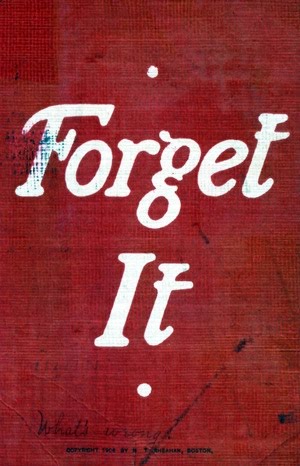
Here's another couple of old postcards from our always-growing collection, both from 1906, and both postally used: this kind of century-old wisdom always seems best, don't you think? It has both a kind of early-twentieth-century folksiness and all the dignity of great age to give it a kind of gravitas, I suppose.

These were both originally copyrighted by M. T. Sheahan, from Boston, Mass; each card reads, above the space for the address, "Sheahan's Good Mottos make the world brighter." It's hard to disagree: the brilliant carmine ink on the "Don't Grunt" card looks brand new, though the other card is showing its age a bit. If you ask me, the dancing pig is an especially nice touch.

We bought these at completely different times and places, probably for about a dollar each: that's generally our limit on silly postcards. What's remarkable is that for a dollar we can still find something like this that can make us smile: it's a dollar well spent, I say.

Here and now, during finals week, I'm trying to take the messages to heart. I have a real tendency to grunt, I'm afraid, but for the time being at least, I'm going to try to concentrate on doing my stunt.

We'll see where that gets me. If it doesn't get me too far, I can always forget it. But I'm probably more likely to go back to grunting.

Saturday, April 24, 2010

Football heroes of 1910

I'm pretty sure this is the only record of anyone, on any branch of my family tree, ever having had any kind of athletic prowess.

The guy third from the right on the front row, sitting on the ground and looking off to the side (as if he's gearing up for his next opponent) is my mother's father, Harry Toothman.

This is a picture postcard that was pasted into a scrapbook about his life that my grandmother put together after he died in 1966.

I was less than a year old at the time, so I never knew him, though my older siblings tell me he was the perfect grandfather: he read to them, took them fishing, and famously assured my then-eight-year-old sister "We won't tell your grandmother about this" when the pineapple upside-down cake they were transporting to a church bake sale slid off my sister's lap and onto the floor of the car.

I'll be writing more about him and about the material in this scrapbook in the weeks to come (fair warning to those of you who are sick of these family-history type posts). But I've been amazed at how much stuff from the scrapbook resonates with me, on many levels.

Morris Harvey College later became the University of Charleston (WV).

Sunday, April 18, 2010

Sixty-five years ago today

On April 18th, 1945, my Dad was interviewed by Armed Forces radio in the Po Valley of Italy, about his job with the 91st Infantry Division. After the war, he requested a copy of the recording, which arrived on a shellac 78 rpm disc...and which, long-time readers won't be surprised to hear, my dad kept all his life.

This is the original interview, to which he added a short introduction some time later, when he transferred it over to audiotape.* I'm not sure when he did this, though his voice still sounds quite young to me, so I imagine it was at least thirty or forty years ago.

Happily, he did get to "go home where it's quiet" soon after this recording, since V-E Day happened less than three weeks later.


*And thanks to my brother, Mark Hathaway, who had the foresight to digitize the whole thing a few years ago! Good thing Dad's techie gene got passed down.