Today marks the 150th anniversary of West Virginia statehood. Its contentious history, past and present, makes it a place that's difficult to love at times. But there's no denying its incredible natural beauty. Emmylou Harris captures both sides of the coin in this song.
And should you need to know more, the Charleston Gazette has "Ten things to know about the West Virginia sesquicentennial." Including, perhaps most importantly, that there will be free cupcakes at interstate welcome centers today.
Here's to more wild, wonderful years to come.
Thursday, June 20, 2013


Tuesday, March 12, 2013
The art of deception and the deception of art
In the last few days, I've encountered two recent works of art that I ravenously consumed, with the emphasis on "rave," and then had second thoughts about: the Oscar-winning Argo, and Ian McEwan's latest novel, Sweet Tooth. By sheer coincidence, both are about covert government operations in the 1970s, and the plot of both turns on the idea of art as political tool and sham. And in the end, both left me feeling like I was the ultimate "victim" of their deceit, in ways that were initially pleasurable but vaguely distasteful afterward.
Argo, as you no doubt know, is about the CIA's successful mission to get six American hostages out of Tehran after the embassy was seized in 1979. Improbably, the operative, played by Ben Affleck, pulls off this extraordinary rescue by posing as a Hollywood producer scouting locations for a desert-based science-fiction film.
The movie is tremendously suspenseful, and Affleck has a hang-dog, bearded earnestness that forces the viewer not only to root for his success, but to share his disappointment that no one could know about it afterward. Archival footage of the revolution alternates with vivid, contemporary restagings that make it viscerally clear just how terrifying it must have been to be in Tehran at the time.
But the movie ultimately emphasizes how terrifying it was to be an American in Tehran at the time. The Iranians, with the exception of the Canadian ambassador's housekeeper, are portrayed utterly homogeneously, united in their seething, mob-like mentality. (Read Marjane Satrapi's wonderful Persepolis for a sense of how terrifying the Revolution was for many Iranians, too.)
Though a couple of the hostages are fluent in Farsi, there's no translation of the angry shouts and accusations they face when, posing as a film crew, they go into the bazaar to meet with government officials. This omission underscores the film's portrayal of the Americans as innocent victims of screaming, incoherent maniacs.
The "happy" ending seems to suggest that it was our great good fortune that such savages weren't nearly worldly enough or smart enough to figure out that they'd been duped until it was too late. As the Swiss Air flight the freed hostages take out of Tehran leaves Iranian airspace, they pop champagne and whoop it up, while the other passengers--silent, anxious-looking "natives"--look on in bewilderment. Back at the airport, the security guards rapturously pass around the storyboards that the "director" bequeathed them as he entered the jetway. The moral of the story seems to be that even our bad, fake American art is slick and effective enough to fool these rubes, and thank God for that.
As the credits rolled, I felt duped: I thought Ben Affleck was a liberal? You wouldn't know it by this reactionary film, whose final scenes show his operative-with-a-heart-of-gold character embracing his wife while the American flag waves on the front porch behind them.
Sweet Tooth, too, is about covert ops, but in England in the early 1970s, when MI5 was shifting its concerns from the Cold War to IRA terrorism. The plot revolves around narrator Serena Frome, a recent maths graduate of Cambridge, who's tapped to join the service and eventually becomes part of the agency's "Sweet Tooth" program, which seeks out and funds conservative-learning writers. The catch is that the writers aren't to know that they're on the MI5 payroll: their stipend comes through a nonprofit foundation, and Serena's cover is that she's sort of a talent scout for a third organization that the Foundation uses to locate promising writers.

In classic spy-novel cliché, Serena falls in love with her "target," a young writer named Tom Haley whom she's assigned to bring into the program. Her deception, then, is double: not only is she posing as someone she's not professionally, but personally as well. Haley has published a few anti-Communist articles and several short stories, but hasn't yet written a novel. Serena's job is to get him to write one, which he does, though it's a grim, post-apocalyptic affair that hardly touts the blessings of capitalism and democracy. But by the time he's done, she's too much in love with him to critique its politics.
That's about all that can be said of the plot without spoilers, but as you might expect from a spy novel, there are several unexpected plot twists along the way, things that turn out not to be at all what they seem: some things turn out to be more benign and even more banal than expected, others more sinister. The big twist at the end, though, has less to do with espionage than it does with art and narrative, and the mutual, willing deception that authors and their readers engage in and co-create.
While the ending is clever, and I appreciate McEwan's meditation on the artifice of fiction and reader's willing participation in it, I also found myself feeling more like the butt of the joke than someone who's in on it. Part of this is due to a vague misogyny that comes through in the end, coloring what's come before. But part of it stems from the sense, like the one I felt at the end of Argo, that I'd been conned into thinking I was consuming one kind of art only to have it morph into something decidedly less pleasurable and more pedantic.
In the last few pages of the novel, Healy contemplates the work of other, older writers who were pulled into secret government work during WWII. He asks, "Who says that poetry makes nothing happen? Mincemeat succeeded because invention, the imagination, drove intelligence. By miserable comparison, Sweet Tooth...reversed the process and failed because intelligence tried to interfere with invention."
Perhaps both of these works are really about nostalgia, a longing for that time when invention drove intelligence, when the government didn't manufacture its fictions in-house, but actually needed real artists--Hollywood makeup artists and literary writers--to pull off their deceptions.
But Argo and Sweet Tooth set out to deceive their audiences. And that's an artistic con that wish I hadn't fallen for twice in as many days.
Argo, as you no doubt know, is about the CIA's successful mission to get six American hostages out of Tehran after the embassy was seized in 1979. Improbably, the operative, played by Ben Affleck, pulls off this extraordinary rescue by posing as a Hollywood producer scouting locations for a desert-based science-fiction film.
 |
| CIA agent Mendez drills his "cast" of hostages on their new identities as Canadian film executives |
The movie is tremendously suspenseful, and Affleck has a hang-dog, bearded earnestness that forces the viewer not only to root for his success, but to share his disappointment that no one could know about it afterward. Archival footage of the revolution alternates with vivid, contemporary restagings that make it viscerally clear just how terrifying it must have been to be in Tehran at the time.
But the movie ultimately emphasizes how terrifying it was to be an American in Tehran at the time. The Iranians, with the exception of the Canadian ambassador's housekeeper, are portrayed utterly homogeneously, united in their seething, mob-like mentality. (Read Marjane Satrapi's wonderful Persepolis for a sense of how terrifying the Revolution was for many Iranians, too.)
Though a couple of the hostages are fluent in Farsi, there's no translation of the angry shouts and accusations they face when, posing as a film crew, they go into the bazaar to meet with government officials. This omission underscores the film's portrayal of the Americans as innocent victims of screaming, incoherent maniacs.
The "happy" ending seems to suggest that it was our great good fortune that such savages weren't nearly worldly enough or smart enough to figure out that they'd been duped until it was too late. As the Swiss Air flight the freed hostages take out of Tehran leaves Iranian airspace, they pop champagne and whoop it up, while the other passengers--silent, anxious-looking "natives"--look on in bewilderment. Back at the airport, the security guards rapturously pass around the storyboards that the "director" bequeathed them as he entered the jetway. The moral of the story seems to be that even our bad, fake American art is slick and effective enough to fool these rubes, and thank God for that.
As the credits rolled, I felt duped: I thought Ben Affleck was a liberal? You wouldn't know it by this reactionary film, whose final scenes show his operative-with-a-heart-of-gold character embracing his wife while the American flag waves on the front porch behind them.
Sweet Tooth, too, is about covert ops, but in England in the early 1970s, when MI5 was shifting its concerns from the Cold War to IRA terrorism. The plot revolves around narrator Serena Frome, a recent maths graduate of Cambridge, who's tapped to join the service and eventually becomes part of the agency's "Sweet Tooth" program, which seeks out and funds conservative-learning writers. The catch is that the writers aren't to know that they're on the MI5 payroll: their stipend comes through a nonprofit foundation, and Serena's cover is that she's sort of a talent scout for a third organization that the Foundation uses to locate promising writers.

In classic spy-novel cliché, Serena falls in love with her "target," a young writer named Tom Haley whom she's assigned to bring into the program. Her deception, then, is double: not only is she posing as someone she's not professionally, but personally as well. Haley has published a few anti-Communist articles and several short stories, but hasn't yet written a novel. Serena's job is to get him to write one, which he does, though it's a grim, post-apocalyptic affair that hardly touts the blessings of capitalism and democracy. But by the time he's done, she's too much in love with him to critique its politics.
That's about all that can be said of the plot without spoilers, but as you might expect from a spy novel, there are several unexpected plot twists along the way, things that turn out not to be at all what they seem: some things turn out to be more benign and even more banal than expected, others more sinister. The big twist at the end, though, has less to do with espionage than it does with art and narrative, and the mutual, willing deception that authors and their readers engage in and co-create.
While the ending is clever, and I appreciate McEwan's meditation on the artifice of fiction and reader's willing participation in it, I also found myself feeling more like the butt of the joke than someone who's in on it. Part of this is due to a vague misogyny that comes through in the end, coloring what's come before. But part of it stems from the sense, like the one I felt at the end of Argo, that I'd been conned into thinking I was consuming one kind of art only to have it morph into something decidedly less pleasurable and more pedantic.
In the last few pages of the novel, Healy contemplates the work of other, older writers who were pulled into secret government work during WWII. He asks, "Who says that poetry makes nothing happen? Mincemeat succeeded because invention, the imagination, drove intelligence. By miserable comparison, Sweet Tooth...reversed the process and failed because intelligence tried to interfere with invention."
Perhaps both of these works are really about nostalgia, a longing for that time when invention drove intelligence, when the government didn't manufacture its fictions in-house, but actually needed real artists--Hollywood makeup artists and literary writers--to pull off their deceptions.
But Argo and Sweet Tooth set out to deceive their audiences. And that's an artistic con that wish I hadn't fallen for twice in as many days.
Saturday, February 2, 2013
The hog whisperer
I think it probably goes without saying that I was a weird kid. I was also a kid who was obsessed with cats. I hounded (no pun intended) my parents about getting a cat until they finally relented. When we went to Cat Welfare to pick out a kitten, we took along our family friend Dottie, who had three cats of her own and who had taught me very carefully how to properly pick up and hold a cat.
This technique has worked with pretty much every cat I've ever had up until the present: our black cat, Stella, doesn't like to be picked up or held at all, and has let me know in no uncertain terms that not only is this technique not "proper," it's tantamount to abuse, and if I keep it up she'll report me to the authorities.
Still, the method has generally served me well, especially on one particular occasion.
My grandmother lived in the very small town of Athens, West Virginia, and when I was growing up, we'd often go down to visit. Trouble was, there wasn't a whole lot to do in Athens, and the options were further limited by my grandmother's ideas about what was proper for girls to do. So, I often entertained myself by walking through the cemetery that was just down the hill from her house. There was a path at the back of the cemetery that led down to a barn and a small pond on some land she owned further down the hill, and it was kind of fun to play "pioneer" down there.
One summer day when I was about eight or thereabouts, I was on my way back from the pond, wandering through the cemetery and reading the headstones, when I caught a flash of something furry out of the corner of my eye. A cat, perhaps? It was about the right size.
I followed it and discovered that it was, instead, a groundhog. He was just ambling along, and when he noted me following him, he stopped. I crouched down and made the usual clucking noises you make to get a cat to come to you, and much to my surprise, he kind of wandered over in my direction.
Or maybe he didn't: to be honest, I don't remember. I like to imagine that I enchanted him, like a groundhog whisperer, and he realized that I was a Trustworthy Gentle Person.
At any rate, he stopped, or moved slowly enough that I was able to pick him up, flip him on his back like I'd been taught to do with cats, and carry him back to the house.

I remember being so excited to show everyone what I'd found in the cemetery--my very own pet groundhog!
My mother, of course, tells me that the adults were freaking out when I came in the house cradling a groundhog, but didn't want to alarm me (or the hog). So, they very helpfully suggested putting it out on the fenced-in stone patio behind my grandmother's house, where I could visit with it. And my dad (in typical fashion) maintained enough presence of mind to snap a picture.
The groundhog and I stayed out there for quite awhile. I probably fed it something; I don't recall. What I do remember is that when I got up the next morning, the groundhog was gone. I was disappointed, though in hindsight, it was remarkable that it stuck around at all after I put it down!
A few years ago this incident came up at a family dinner and my parents said they supposed the groundhog was sick; why else would it let a kid pick it up and carry it around?
To be honest, though I was well into my forties by then, that thought had never occurred to me. For the first time ever I was able to see the event as an adult would: Holy crap, does that thing have rabies?! Put the pest-ridden wild animal down slowly, little girl.
In addition to the photo, that's the thing I'm most happy to have taken from that experience: the knowledge that at one point in my life, I was innocent and trusting and bold enough* not to worry about such things.
Happy Groundhog Day, everyone!
*and stupid! Did I mention stupid?
 |
| Dottie demonstrating proper cat-holding technique on the day we got Ginger, my first cat |
 |
| --and me holding one of Dottie's cats. |
This technique has worked with pretty much every cat I've ever had up until the present: our black cat, Stella, doesn't like to be picked up or held at all, and has let me know in no uncertain terms that not only is this technique not "proper," it's tantamount to abuse, and if I keep it up she'll report me to the authorities.
Still, the method has generally served me well, especially on one particular occasion.
My grandmother lived in the very small town of Athens, West Virginia, and when I was growing up, we'd often go down to visit. Trouble was, there wasn't a whole lot to do in Athens, and the options were further limited by my grandmother's ideas about what was proper for girls to do. So, I often entertained myself by walking through the cemetery that was just down the hill from her house. There was a path at the back of the cemetery that led down to a barn and a small pond on some land she owned further down the hill, and it was kind of fun to play "pioneer" down there.
One summer day when I was about eight or thereabouts, I was on my way back from the pond, wandering through the cemetery and reading the headstones, when I caught a flash of something furry out of the corner of my eye. A cat, perhaps? It was about the right size.
I followed it and discovered that it was, instead, a groundhog. He was just ambling along, and when he noted me following him, he stopped. I crouched down and made the usual clucking noises you make to get a cat to come to you, and much to my surprise, he kind of wandered over in my direction.
Or maybe he didn't: to be honest, I don't remember. I like to imagine that I enchanted him, like a groundhog whisperer, and he realized that I was a Trustworthy Gentle Person.
At any rate, he stopped, or moved slowly enough that I was able to pick him up, flip him on his back like I'd been taught to do with cats, and carry him back to the house.

I remember being so excited to show everyone what I'd found in the cemetery--my very own pet groundhog!
My mother, of course, tells me that the adults were freaking out when I came in the house cradling a groundhog, but didn't want to alarm me (or the hog). So, they very helpfully suggested putting it out on the fenced-in stone patio behind my grandmother's house, where I could visit with it. And my dad (in typical fashion) maintained enough presence of mind to snap a picture.
The groundhog and I stayed out there for quite awhile. I probably fed it something; I don't recall. What I do remember is that when I got up the next morning, the groundhog was gone. I was disappointed, though in hindsight, it was remarkable that it stuck around at all after I put it down!
A few years ago this incident came up at a family dinner and my parents said they supposed the groundhog was sick; why else would it let a kid pick it up and carry it around?
To be honest, though I was well into my forties by then, that thought had never occurred to me. For the first time ever I was able to see the event as an adult would: Holy crap, does that thing have rabies?! Put the pest-ridden wild animal down slowly, little girl.
In addition to the photo, that's the thing I'm most happy to have taken from that experience: the knowledge that at one point in my life, I was innocent and trusting and bold enough* not to worry about such things.
Happy Groundhog Day, everyone!
*and stupid! Did I mention stupid?
******************UPDATE*********************
Here's my mom's version of events. Needless to say, I did not witness Chuckie's escape.
We were in Athens for an overnight stay
on our way to visit the Beegles and their horses in Charlottesville and
then on to Williamsburg.
You decided to take a
wander--unbeknownst to us--to the cemetery. That's where you discovered
Chuckie, as you called him, sitting tamely among the markers. You
scooped him up and carried him back to Grandma's.
Yes! Dad and I were startled and a
bit worried. It seemed strange to us that a wild animal should be so
amiable--perhaps he was sick. Rabies flitted through our minds. It
took some persuasion to convince you to part with Chuckie: he would
not be happy as a house pet, he was used to country life, we wouldn't know
what to feed him, etc.,etc. Finally you reluctantly agreed to free him and
he scuttled away--under the washhouse as I remember. And your parents
tried not to be too obviously relieved. Now we have the picture and the
memory, thanks to Dad with his ever present camera.
Monday, December 24, 2012
The cards of Christmas past
I am a tradition killer.
It's been years since I've sent out Christmas cards en masse, though in the last couple of years I've sent out Valentines to folks who sent us holiday greetings. I'll probably do that again come February, though at last count, Tom and I had only received about five cards in the mail. I've received several holiday e-cards from people who used to send "real" cards, but in general, the custom of sending these obligatory annual missives seems to be dying a slow death.
That's fine with me, for the most part, since they seem like an added duty at a time of year that's busy and stressful enough. But looking at the handful of cards we received, I also remembered how much I loved retrieving December's mail from the box when I was a kid, looking at all the different kinds of handwriting, the postmarks from places that seemed far away and exotic to me at the time. It was a real treat when my parents let me open them, and even when I didn't get to open them myself, I enjoyed reading them.
In some ways, they were like condensed history lessons about my parents' pasts: where they'd lived, what they'd done, who they'd been long before I was born. There were many old friends of my parents who I only knew through their cards, like my dad's college friend Jim Dukas, who was a professional actor in New York City. His cards were always the funniest ones, and I remember his distinctive, slanty writing that was sort of halfway between print and cursive. I actually met him during a high-school trip to NYC, and in many ways, I felt like I'd always known him.
It's certainly true that we have multiple, ongoing, and more immediate ways of keeping up with old friends these days (Facebook, I'm looking at you), and I certainly wouldn't want to give up social networking in favor of a once-a-year holiday update. But those interactions are (we trust) largely private: you can't display your Facebook wall like you can display a collection of Christmas cards. And of course, they're even more ephemeral that ephemera, as we've written about here before.
Which brings us to this year's collection of holiday ephemera (as opposed to this year's). My mom's ongoing basement excavation recently unearthed a file folder of handmade Christmas cards that my parents sent out in the 1950s and 1960s. My dad, as I've mentioned here before, was a keen amateur photographer, and he also apparently had access to a typesetter and a silk-screening setup at his office. So, they designed and sent out a different card every year.
I'd only seen one of these before, so it was quite a surprise to me to see pretty much the whole run of them come out of the file folder.
This seems to be the first iteration, from when my parents were still living in Morgantown, before my brother Mark was born:
Fortunately, the "Hathmark" logo (!) on the back of each card lets us know when each was produced.

So, here they are, in order of appearance:


There's a story behind the 1960 edition, above, which I hadn't heard before. The drawing at the top is the work of my brother Mark, who was about five at the time. My parents had a contest to decide which of the three kids' pictures would go on the front, and Mark's won. My Dad apparently decided to improve upon the original by adding a belly button right before he printed it. When Mark saw the final version, he burst into tears, saying, "My man has no clothes on!" That'll teach you not to mess with a masterpiece.
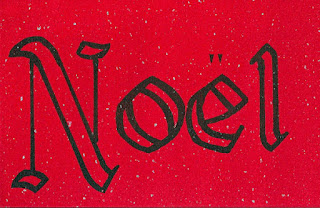

And this elaborate, multi-lingual folding number from 1963:


The tintype was the only one of these handmade cards I'd ever seen before, and there's a reason why, as the 1965 edition foreshadows:

So, there you have it: my arrival apparently ended this tradition. My parents still sent Christmas cards, but store-bought ones. So maybe I'm not so much a tradition-killer as a tradition-modifier.
And I'll continue modifying it now by wishing our readers ( all three of you) a very Merry Christmas (or whatever December holiday you observe) and a bright, beautiful 2013.
It's been years since I've sent out Christmas cards en masse, though in the last couple of years I've sent out Valentines to folks who sent us holiday greetings. I'll probably do that again come February, though at last count, Tom and I had only received about five cards in the mail. I've received several holiday e-cards from people who used to send "real" cards, but in general, the custom of sending these obligatory annual missives seems to be dying a slow death.
That's fine with me, for the most part, since they seem like an added duty at a time of year that's busy and stressful enough. But looking at the handful of cards we received, I also remembered how much I loved retrieving December's mail from the box when I was a kid, looking at all the different kinds of handwriting, the postmarks from places that seemed far away and exotic to me at the time. It was a real treat when my parents let me open them, and even when I didn't get to open them myself, I enjoyed reading them.
In some ways, they were like condensed history lessons about my parents' pasts: where they'd lived, what they'd done, who they'd been long before I was born. There were many old friends of my parents who I only knew through their cards, like my dad's college friend Jim Dukas, who was a professional actor in New York City. His cards were always the funniest ones, and I remember his distinctive, slanty writing that was sort of halfway between print and cursive. I actually met him during a high-school trip to NYC, and in many ways, I felt like I'd always known him.
It's certainly true that we have multiple, ongoing, and more immediate ways of keeping up with old friends these days (Facebook, I'm looking at you), and I certainly wouldn't want to give up social networking in favor of a once-a-year holiday update. But those interactions are (we trust) largely private: you can't display your Facebook wall like you can display a collection of Christmas cards. And of course, they're even more ephemeral that ephemera, as we've written about here before.
Which brings us to this year's collection of holiday ephemera (as opposed to this year's). My mom's ongoing basement excavation recently unearthed a file folder of handmade Christmas cards that my parents sent out in the 1950s and 1960s. My dad, as I've mentioned here before, was a keen amateur photographer, and he also apparently had access to a typesetter and a silk-screening setup at his office. So, they designed and sent out a different card every year.
I'd only seen one of these before, so it was quite a surprise to me to see pretty much the whole run of them come out of the file folder.
This seems to be the first iteration, from when my parents were still living in Morgantown, before my brother Mark was born:
 |
| The 1954 edition, with Phillip and Pam |
Fortunately, the "Hathmark" logo (!) on the back of each card lets us know when each was produced.
So, here they are, in order of appearance:
 |
| 1956: Contract with Santa. Pam's comment: "That looks like the contract Dad drew up for me when I was five and started getting an allowance" (a document she still has, natch). |
 |
| Add caption |
 | |
| 1958: Slightly derivative model, with a copy of a Thurber illustration on the outside and an Ogden Nash ditty on the inside |

 |
| 1959: Apparently, there was someone at Lazarus, a big department store in Columbus, making cutout silhouettes of children before the holidays this year. These are the images made of Phillip, Pam, and Mark, transferred into the holiday card. |


There's a story behind the 1960 edition, above, which I hadn't heard before. The drawing at the top is the work of my brother Mark, who was about five at the time. My parents had a contest to decide which of the three kids' pictures would go on the front, and Mark's won. My Dad apparently decided to improve upon the original by adding a belly button right before he printed it. When Mark saw the final version, he burst into tears, saying, "My man has no clothes on!" That'll teach you not to mess with a masterpiece.

 |
| 1961 edition, on the same silver-speckled paper as the previous year's card |

 | ||
|


 |
| There are, of course, extras: two-sided sheets, one side in red and one in green, ready to be cut up and folded. |

 |
| 1964: Rented old-fashioned clothing, Victorian pose, and an actual tintype print glued into each card. |
The tintype was the only one of these handmade cards I'd ever seen before, and there's a reason why, as the 1965 edition foreshadows:

So, there you have it: my arrival apparently ended this tradition. My parents still sent Christmas cards, but store-bought ones. So maybe I'm not so much a tradition-killer as a tradition-modifier.
And I'll continue modifying it now by wishing our readers ( all three of you) a very Merry Christmas (or whatever December holiday you observe) and a bright, beautiful 2013.
Sunday, December 16, 2012
Merry Strip-mas!
It's been a long, long semester, but yesterday we managed a quick trip up to the Strip District in Pittsburgh to do some Christmas shopping.
The Strip is crowded and lively on any Saturday, but especially during the holiday season! And in addition to the usual seasonal decor, there are some distinctly Pittsburgh-y touches.
The Strip is crowded and lively on any Saturday, but especially during the holiday season! And in addition to the usual seasonal decor, there are some distinctly Pittsburgh-y touches.
 |
| Tables full of greenery |
 |
| Tables full of Italian cookies |
 |
| Ceiling full of piñatas at Reyna Foods |
 |
| "Si se puede, Steelers" sign at the taco stand outside Reyna--where a mile-long line kept us from indulging. (Google Translate says this means "If they can, Steelers": surely there's a better translation?) |
 |
| Festive holiday-themed Terrible Towels...and of course, the ubiquitous breast-cancer pink Terrible Towel |
 |
| "Andiamo, Steelers!" |
 |
| Outside of the amazing Penn Mac. We didn't even try to go to the deli side on this trip--people were packed in there like sardines |
 |
| Huge lines waiting to check out at Penn Mac, where we got several kinds of pasta, three-grain risotto, dried canellini beans, shallots, and other goodies |
 |
| "Ritorna presto": we most certainly will. There's always a great reason to come back to the Strip. |
Saturday, October 6, 2012
Pittsburgh Step Trek

However, today we did get out of town to participate in an event I've been wanting to check out ever since we saw a story about it on Rick Sebak's WQED show "It's The Neighborhoods": the Pittsburgh Step Trek, put on by the South Side Slopes Neighborhood Association: a 3.5 mile walk up and down the hills south of the Monongahela River that includes 1,815 of the public steps that run along and cut between the twisty roads of the neighborhood.
A chilly, rainy morning in Morgantown didn't bode well for an outdoor adventure--but by the time we got up to Pittsburgh early this afternoon, the sun was out, there was a lovely cool breeze, and it turned out to be a total Chamber-of-Commerce, photo-op kind of autumn day.
The walk was a challenge, to say the least...but totally worth it for the amazing views of downtown Pittsburgh and the Cathedral of Learning at the University of Pittsburgh, and for the intangible "Pittsburghness" of the whole event, for lack of a better word.
First ascent: these stairs up from South Side Park to Mission Street...

...past the now-closed Church of St. Josephat, built in 1916 to serve a largely Polish parish, as the language of the cornerstone and the war memorial attest.


Then up 143 steps for some spectacular views of downtown across a weirdly jungle-y landscape...


And then lots more steps and lots more spectacular views.
 |
| Cathedral of Learning at the U of Pittsburgh in the distance |


One of the highlights of this year's tour was its path through an area called "The Hollow," home to the city's Slovak community in the early 20th century (according to the guide, the Pittsburgh area is "home to more Slovaks than any other area in the United States").
The heart of the community was this place, the Kollar Club, more formally known as "The John Kollar Slovak Literary and Library Society." Named for a famous 19th-century Slovak poet, the club is still in operation, "preserving Slovak language and culture, and serving as a venue for live music."

Have I mentioned how much I love Pittsburgh? It's places like these that make this city such a remarkable place. Many older, rust-belt cities may have places that used to house to ethnic clubs; in Pittsburgh, they're alive and well and thriving.
Then up another long flight of steps from The Hollow to Mary Street...

...with a peek into a charming hidden garden on the way...

...and back down some more steps...

...and up and down and up and down some more, until it started to feel a little Bataan-Death-March-like, and we wondered how on earth the steel- and glass-workers who lived in these houses and walked to work in the factories on the river ever made it back up the hill to get home after a long day of work.
And we wondered where they bought groceries, and drank; presumably, back in the day, there were little corner stores and bars at the end of every block. Now everyone seems to have a car, and they probably drive down to one of the many, many bars along Carson Street.
After we finished, we pondered having a drink ourselves, but instead went to Rita's Custard, also on Carson Street. We figured we'd already burned off the calories.


Such an amazing city. Such a great day out. And such an inspiring story behind the group that organizes the event, the South Side Slopes Neighborhood Association.
Apparently, the group started up fifteen years ago after three homes were destroyed in a fire because a standard city fire truck wasn't able to get through the neighborhood's narrow, winding streets to reach them. (Some of the homes in the area can only be accessed by the steps--there's no street access to them at all!) As the guide notes, "they gathered data and succeeded at making the case for a smaller fire truck with a tighter turning basis. The city adopted the new design, and now a number of smaller, more-able fire trucks serve hillside neighborhoods throughout Pittsburgh."
That's what I call successful community organizing.

Subscribe to:
Comments (Atom)